SadaPay · Founding Designer → Head of Product Design · Dec 2020 – Aug 2024

Started from zero.

Four years later — a $50 million exit.

I was hired as SadaPay's first designer in December 2020 with one job: figure out what good fintech could look like in a country that had never seen one. Four years later — 4 million users, $1 billion processed annually, the first numberless card in the MEA region, and Pakistan's first fintech exit.

Scroll
SadaPay brand launch film · 2019
4M+ Users at departure
1 → 8Team, built
$50MPapara acquisition
$1B+Annual volume
4.8★App Store rating

220 million people.
87% unbanked.
A market that had never seen good fintech UX.

The national baseline for "signing up to a bank" was a branch visit, a paper form, and a wait measured in weeks. The State Bank of Pakistan (SBP) wrote its regulations for banks, not apps. Nobody had a reference for what good fintech looked like — because no one had ever built it.

I joined as the first in-house designer. The only design voice in a room of engineers, PMs, and a design-obsessed CEO who had raised $7.2M on a vision of simple banking — the largest seed round by a Pakistani startup at the time.

Nobody had written the playbook. We wrote one that worked.

Six rungs, four years Mid-level Senior Senior II Lead I Lead II Head of Product Design
0 1

The Story

From zero to Pakistan's first fintech exit. Four years, in five chapters.

01 December 2020

The beginning.

When I joined SadaPay as its first designer, the company was raising on a vision — Pakistan's first neobank — but had nothing to show. No product. No team. No brand. I was the only design voice in the building, figuring out what good fintech could look like in a country that had never seen one.

The first job wasn't a screen. It was deciding what kind of product we were building. Pakistan had banks — bureaucratic, paper-first, designed for the teller, not the user. Everything we'd ship had to feel like the opposite of that.
02 2021 · The Waitlist

200,000 people signed up to wait for a product that didn't exist yet.

Before we shipped a single feature, we ran a gamified waitlist. Golden tickets, referral mechanics, branded Founders Club cards — the black edition in particular became a cultural object people referenced by name. It grew to 200,000 signups pre-launch. Eventually past 700,000. No paid acquisition.

SBP granted us a trial license — 1,000 users to onboard, extended to 10,000. We invited friends and family, then early adopters. They got hoodies, goodies, merchandise, the black Founders Club card. The hype built before the doors opened.

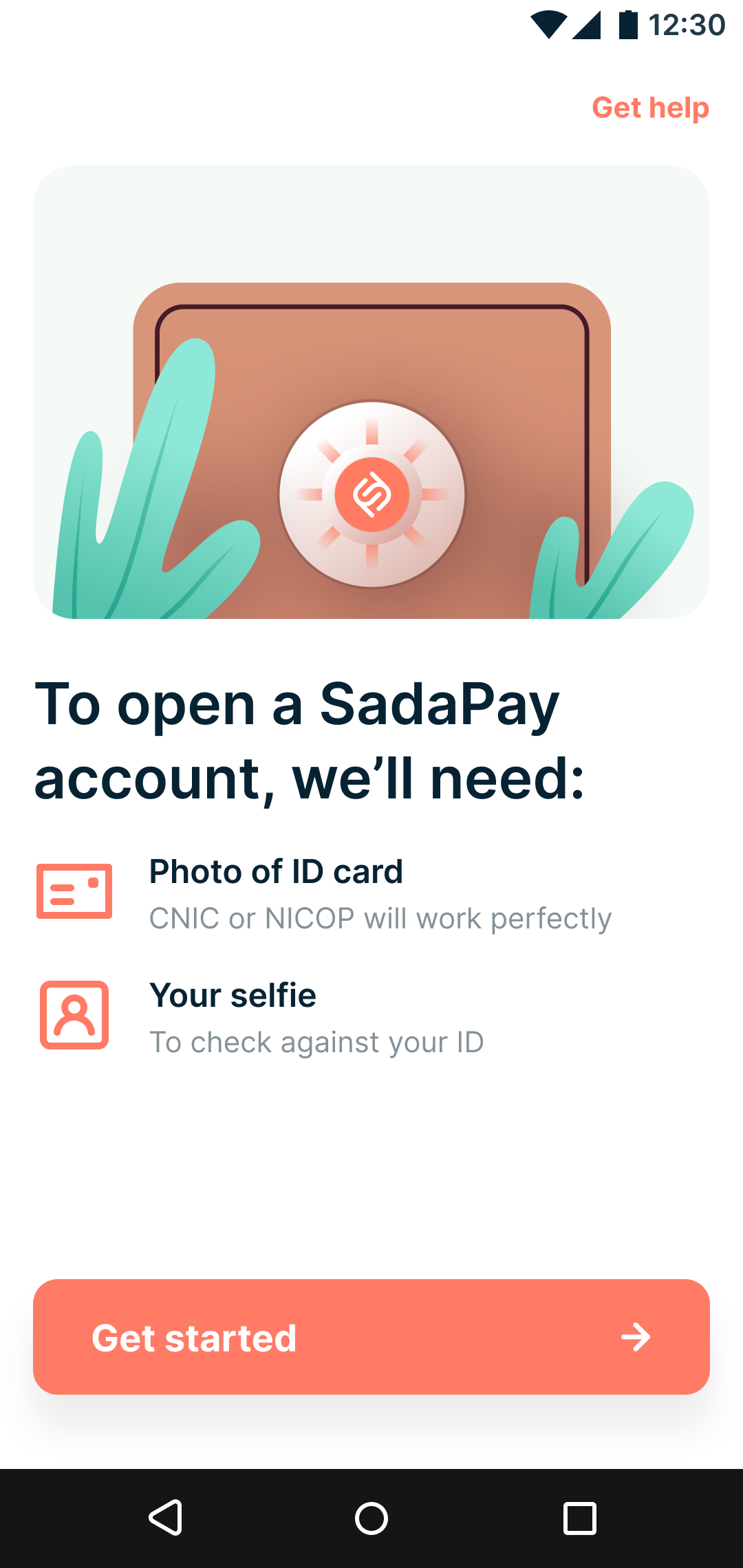
SadaPay KYC onboarding flow
03 2021–2022 · The Launch

We couldn't print cards fast enough.

Public rollout hit and demand crushed our fulfillment. Physical cards ran out within days — people lined up for a piece of plastic in a country where nobody had ever lined up for a debit card before.

Onboarding took under two minutes in the app — CNIC scan, biometric liveness check, PIN setup. We were also the first neobank in Pakistan to integrate a Biometric Verification System with NADRA (the national ID authority), so users could verify by scanning a fingerprint through the camera. Higher limits, a layer of trust the category hadn't had.

We crossed 1 million, then 2 million users — and kept going. App Store hit 4.8★. Play Store 4.7★. Pakistan's largest neobank before the market had figured out what we were building.

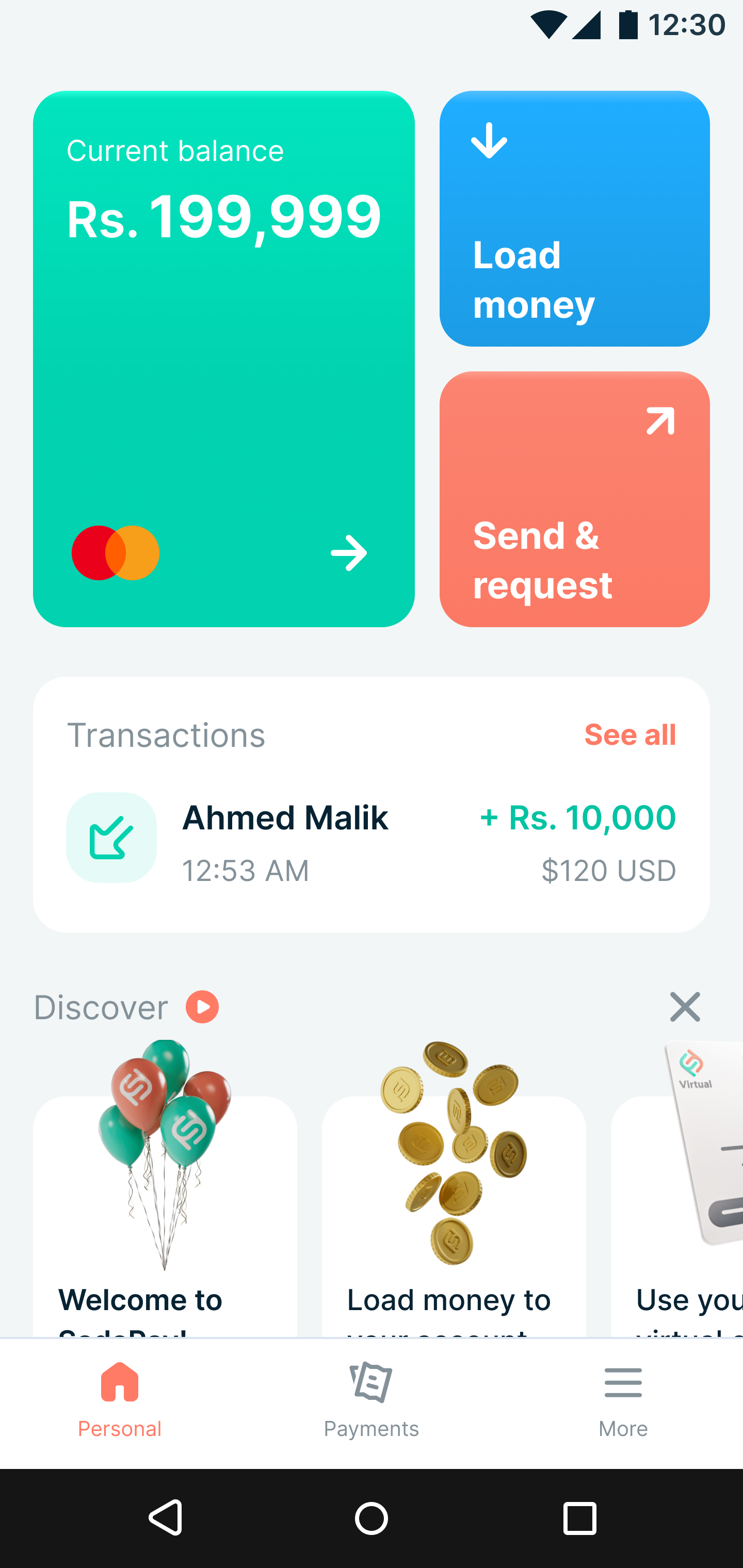
SadaPay home balance screen
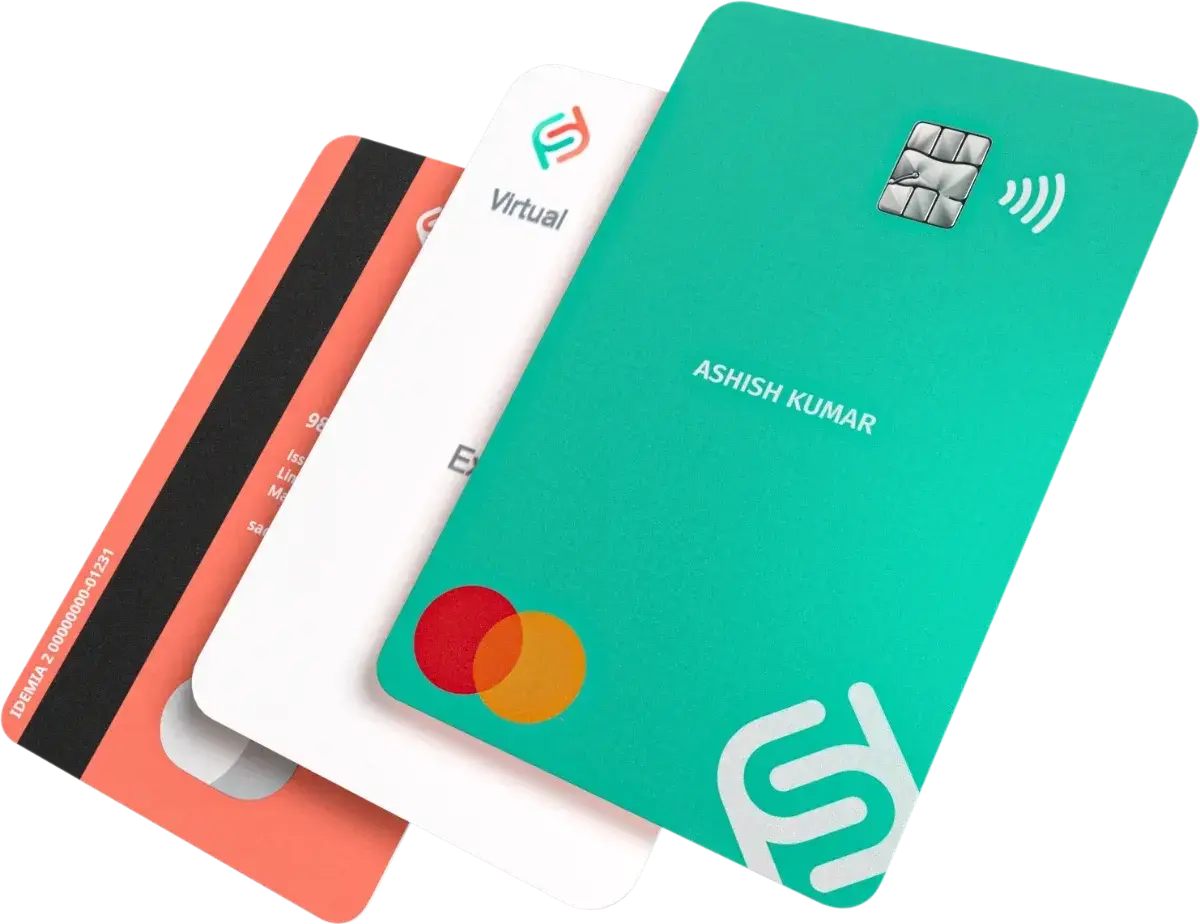
SadaPay numberless card — teal front, peach back

The Card

The decision I'm most proud of.

No card number. No CVV. No expiration date. When a card gets stolen in Pakistan, everything needed for fraud is printed on it — we eliminated that entirely. Card details live only in the app, behind biometrics and PIN.

But the card became more than a security decision — the hero of the brand. A deliberate departure from every bank card people had seen before. It didn't look like a bank card at all. People were talking about a debit card in Pakistan. That had never happened.

The card is the hero of our brand — a physical representation of how we do things differently.

Brandon Timinsky · CEO & Founder
04 2022–2023 · The Scale

Two verticals took us past $1 billion a year.

SadaBiz — invoicing for Pakistan's freelancers. A country with no PayPal and no Wise. We built a payment-link platform: freelancer creates an invoice, client pays with Apple Pay or Google Pay, freelancer gets paid in three days. Grew transaction volume 441% ($160K → $869K a month) and cut fraud 79% (3.26% → 0.67%) through service-design blueprints.

SadaSchool — free education for young Pakistani freelancers. Courses on graphic design, coding, management — in a Notion-backed library, a Discord community, and weekly live sessions run by the country's top Upwork and Fiverr earners. A personal wallet, a business wallet, and the skills to earn into them — all inside one app.

By this point we were processing $1 billion a year.

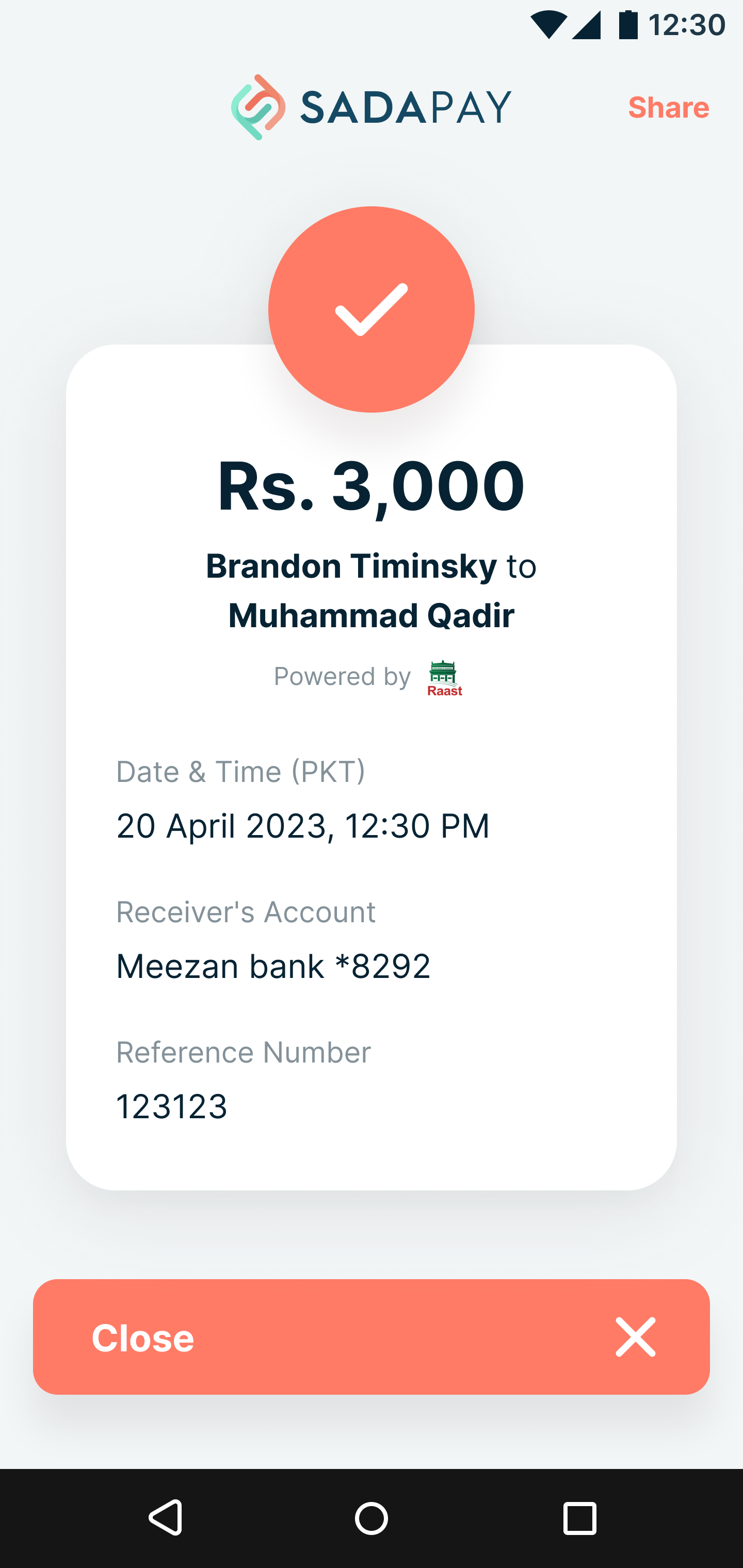
SadaPay send money success
05 August 2024 · The Exit

Papara, $50 million. Pakistan's first fintech exit.

Offers came in. We picked Papara — the Turkish fintech. Acquisition closed for approximately $50 million.

We'd gone from a shared office and no designs to Pakistan's first fintech exit in four years. I left the product in the hands of the team I'd built.

Service design

Service Blueprint.

Product designers fix screens. I mapped the entire service. Two places where that paid off.

01 · Fraud

Front stage and back stage.

In 2022, SadaPay was seeing fraud attempts that no single screen could stop. The gaps were in the spaces between screens — verification timing, CX scripts, edge cases where legitimate users got flagged while actual fraud passed.

I built a full service blueprint — every front-stage flow mapped against every backstage operation and system. The fix wasn't a new screen. It was a systemic redesign.

−79% Fraud rate · 3.26% → 0.67% on SadaBiz
02 · Customer experience

The CX team was drowning.

Support volume kept climbing. The team had hired more and more agents but couldn't catch up. They came to design for help — the first time design had been pulled into a CX scaling problem.

I pulled together every data source — Intercom chats, Jira tickets, Mixpanel events — and mapped the full support journey. Root causes showed up in the product, not the inbox. Service redesign cut volume sustainably. The CX team stopped scaling with headcount and started scaling with design.

His attention to detail in service design is one of his superpowers. Brandon Timinsky · CEO & Founder

The Foundations I Built

Products are the visible work. This is the quieter one — the operating system that ran the team without me in the room.

Foundation 01

Hiring framework

Built end-to-end with the recruiting team: new JDs, a Product Designer Recruitment Guide, Technical Interview scorecards, a Career Progression Framework spanning Associate → Mid → Senior → Lead, and a design challenge calibrated to SadaPay's actual constraints — replacing the old generic portfolio review. Designers who thought, not decorated. 15–20 hired through the pipeline, 8 on the core team at peak.

02

Research practice

Built from zero. A Notion-backed research repo: recruitment protocols, interview methods, synthesis templates, study archive. Research lived in the review cycle, not as a side artifact.

03

Data analytics practice

No analytics culture existed. I wrote Mixpanel event specs into every handoff, stood up dashboards for success metrics, and partnered with data engineering so design decisions became measurable.

04

Design-engineering collaboration

Squads, pairing, hot-potato co-authorship. We hate handoffs — we built alongside. Design jams, weekly design reviews, engineers in the Figma file.

05

Career framework

Clear levels with skill matrices — the same ladder I walked up. Growth plans for every designer. 1:1s structured around development, not status.

06

Crit rituals

Weekly crits where the newest junior could challenge a Lead's work. Monthly showcases. Quarterly retros. Safety built into the rhythm, not hoped for.

07

Design ops & governance

File versioning, asset management, design system governance. The last layer I put in place — the one that let the system run itself when I wasn't in the file.

08

Cross-functional squads

Design embedded with CX, legal, compliance, and marketing — not in a service relationship, inside the same squad. Legal on the research calls. Compliance in the design reviews. Marketing briefed before build, not after.

More work

Deep dives on the systems and products inside the story above.

Growth · Deep dive

The Waitlist

How a gamified pre-launch waitlist — Founders Club, golden tickets, black cards — grew past 700,000 signups with zero paid acquisition, and turned into the highest-transacting cohort post-launch.

Read the Waitlist case study
Coming soon

SadaSchool · BVS · Mission Control

Education platform for freelancers, biometric verification with NADRA, and the internal ops panel serving 10+ teams and 50+ support associates. Separate case studies — on the way.

What they said

SadaPay was praised for how well designed the product is — this is thanks to Basit and the exceptional product design team he built.
Brandon Timinsky CEO & Founder, SadaPay
Basit is an insanely good UX designer. He built the foundations of the SadaPay mobile experience, which is recognized as world-class.
Sergio Schüler Head of Product, SadaPay
He introduced our design system which allowed our app to have a great consistent design. He pushed for an uncommonly close design-engineering relationship.
Jon Sheppard CTO & Board, SadaPay
He consistently trusted and empowered us to take ownership of our projects.
Sohaib Arif Product Designer, SadaPay
I considered him our Head of Design, and one of my peers. He made design integral, not just a production line.
Eli Mydlarz Head of Engineering, SadaPay
Basit took what was basically ground zero for a product and built cohesive design systems that were incredibly versatile and gorgeous.
Nikita Protsenko Product Designer, SadaPay
Among all the Product Designers I've had the pleasure of working with, Basit stands out as the most user-focused and data-driven designer.
Swaleha Saleem Solutions Architect, SadaPay
Back to all stories
Next Story ZAR